
On Thursday 12 November, Nvidia told the US securities regulator that Jensen Huang is leaving, "effective immediately", his posts as president, chief executive and board member of the company he co-founded in 1993. Colette Kress, its chief financial officer, takes over on an interim basis, and Harvey C. Jones becomes the first chair of the board in the company's history. Some headlines already speak of a collapse and of an AI expansion in danger. It is worth looking at the figures before buying into the scare.
The share price fell as much as 13% before the open, according to Variety, and up to 16% after the announcement, according to NBC News, but closed the session down 4.3%, at 166.19 dollars. At that price, Nvidia is still worth about 4 trillion dollars. The Nasdaq lost as much as 1.5% during the day, according to AP. It is a serious blow for shareholders, not the collapse of an industry. The board says operations, customer commitments and the product roadmap will continue "without interruption".
What does deserve a column is what this crisis has laid bare. According to Silicon Analysts, Nvidia controls around 80% of the market for AI accelerators by revenue, with 193,700 million dollars of data centre sales in its last financial year. And that company had never had a board chair other than its founder: it has appointed one now, on the very day he left. NBC News describes it as a major governance overhaul at a company that for decades relied solely on Huang.
The reason for his departure is not minor either. Huang is leaving after reports by The New York Times about personal relationships, one of them with a Chinese businesswoman who, according to that newspaper, was recruited by China's Ministry of State Security to obtain information about Nvidia's chips. President Trump confirmed that the FBI is investigating that relationship and said he believed Huang's assertion that he was unaware of those ties, according to Variety. None of this has been tried in court, and nobody's private life is the business of this column. What is its business is that the security of the technology underpinning much of the world's artificial intelligence could also depend on the personal relationships of a single person.
The best counter-argument is solid: Nvidia is not one man. It has a management team with years at the company and a technical advantage that leaves with no one. CUDA, the software that turned its chips into the industry standard, was invented by Ian Buck, who is still at the company, according to CNN. Competition is also advancing: in-house chips from Google, Amazon or Broadcom are growing faster than AMD, according to Silicon Analysts. Markets overreact, and Thursday's close proves it.
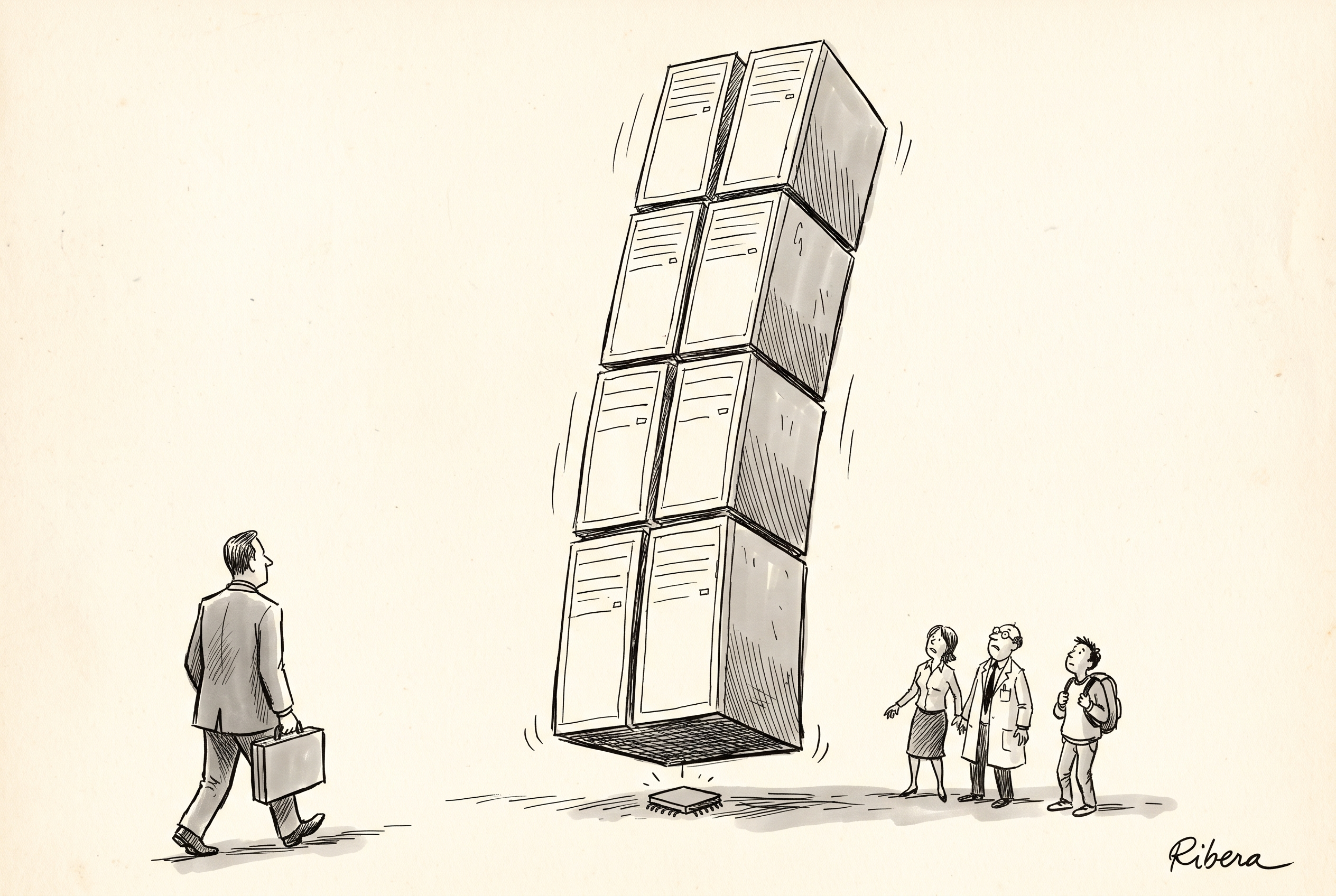
I am not fully convinced, because it confuses the company with the system. That Nvidia will survive Huang is likely. That half the world depends on a single supplier for a technology that governments and companies already treat as infrastructure is the problem, whoever wins the succession. A system with a single point of failure is not fixed by changing the person who sits at that point.
Spain is no exception. The accelerated partition of MareNostrum 5, the Barcelona Supercomputing Center's supercomputer, runs on Nvidia H100 processors, according to the TOP500 list. Nor is this newsroom: the cartoon accompanying this column is generated with Higgsfield, a company Nvidia has invested in, according to Variety. I do not say this to alarm anyone, but because that is how invisible dependencies work: they are everywhere and only become visible when something creaks.
The sensible response is neither panic nor boycott. It is what is demanded of any critical infrastructure: knowing who each service depends on, diversifying suppliers where possible and asking the companies that sustain it for governance that matches their weight. Nvidia has taken a first step by separating the chair of the board from the chief executive. Governments, research centres and the companies that buy its chips have homework to do.
The expansion of artificial intelligence is not at risk because a chief executive resigned. It would be if the next crisis at its dominant supplier finds us as this one did: without a plan B.
This story stands on its own facts. The Post Apocalyptic does not link it to other incidents unless the sources demonstrate a connection.
Sources
- Nvidia Announces CEO Transition
- Nvidia CEO Jensen Huang Resigns After Multiple Affairs, Including With Alleged Chinese Spy
- Nvidia CEO Jensen Huang resigns after reports of affair and extramarital relationships
- Jensen Huang resigns as Nvidia CEO
- Caída de acciones de Nvidia arrastra a Wall Street
- AMD vs NVIDIA AI GPU Market Share 2026
- MareNostrum 5 ACC - BullSequana XH3000, NVIDIA H100 64GB
Public history
- — Published (editorial approval)