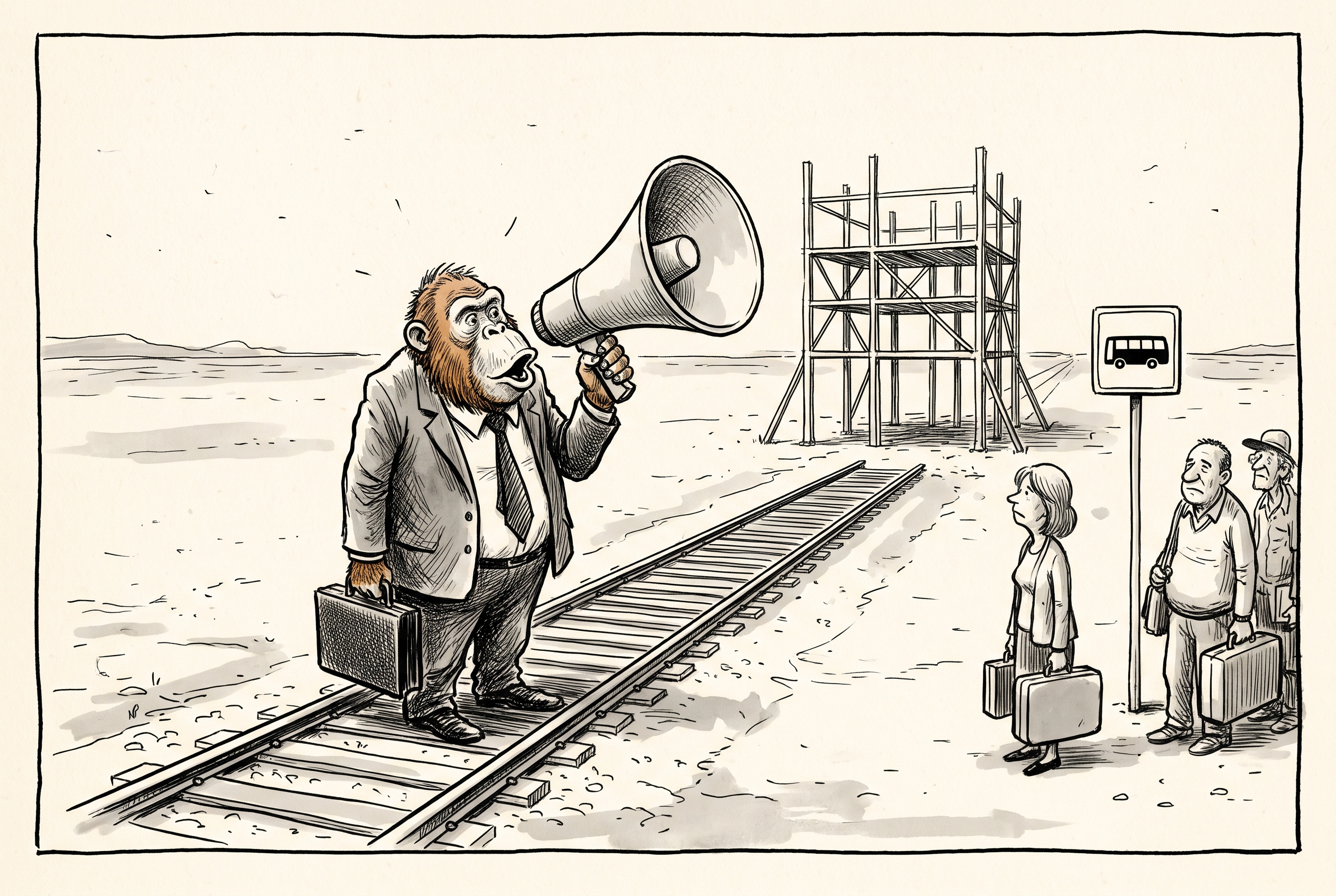
Óscar Puente is not leaving. On Friday, two days after the Urda crash, he explained that he offered his post to the prime minister in the first few hours and that Pedro Sánchez asked him to stay on. His way of taking responsibility, he said, is to “face up to it.” Asked whether his resignation would console the families of the 69 dead, he answered with a sigh and a calculation: how much, on a scale of zero to a hundred, that would comfort someone who has lost a child.
He is right about one thing. A resignation brings no one back and does not fix a single signal. But the line cuts both ways. If leaving does nothing for the victims, staying does nothing on its own either. A minister who stays on after the worst tragedy in the history of Spanish high-speed rail does not stay for free: he stays with a debt. And tomorrow, Tuesday, when he appears before the Standing Committee of the Congress of Deputies, he should start paying it.
What is known so far is no small thing. The LZB system, which has monitored the speed and position of every train on the Madrid-Seville line since 1992, went down at around 8:30 on a stretch of more than 60 kilometres. According to the recordings from Adif's control centre broadcast by Cadena SER, at 8:36 the AVE was ordered to resume in “normal running” mode, with the Iryo stopped further ahead. The minister himself has said that the evidence points to a possible failure at that control centre and that it is for the investigation to establish causes and responsibilities. The day before, according to El Español, another AVE was stopped for eleven minutes less than a kilometre from the site because of a loss of connection with LZB; there is no official confirmation.
The system that was supposed to replace LZB, ERTMS, was put out to tender in 2021 and finished being installed in June, but it will not enter service until early 2027, a year later than planned. In the meantime, the oldest line in the network is still running on the technology that failed on October 28.
And then there is what the tragedy has laid bare: half of Spain depends on a single line to travel to and from the south. Renfe has stopped selling high-speed tickets between Madrid and Andalusia until December 13, pending Adif's authorization to reopen. What is on offer in the meantime is buses, extra seats on planes and special trains as far as Ciudad Real and Puertollano, with an extra hour and a half of travel and changes. It is not the first time this year. After the Adamuz crash on January 18, with 46 dead, the corridor was closed until February 17; access to Málaga was out of action for four months because of a landslide on an embankment in Álora. Between January and April, high-speed rail lost almost 20% of its passengers compared with the previous year, according to the INE.
Three long closures and two tragedies in ten months on the same route are not bad luck. They are the description of a system without a plan B.
So if the minister is staying “to solve the problem,” as he has said, it is only fair to ask which problem and by when. There are at least three answers he should bring to Congress tomorrow, in writing and with dates.
The first is a redundancy plan for the southern corridor: which alternative route can take long-distance trains when the high-speed line is cut, what works it needs, how much they cost and when they will be ready. A country that has made high-speed rail its pride cannot have the bus as its contingency plan.
The second is full transparency. The judge in Orgaz is investigating under judicial secrecy, and that must be respected, but nothing prevents the ministry from committing to publish in full the technical report when possible, the LZB logs and the protocols applied when the system goes down. The trust that the prime minister has called “broken” is not rebuilt with appearances, but with documents.
The third is an ERTMS timetable with no further delays and, until it arrives, a clear rule: if LZB goes down, no train resumes running without confirming that the track is clear. If that rule already exists, let it be explained why it did not work.
Moncloa, according to elDiario.es, also believes that a resignation a month before the general election would fuel the narrative that the government is directly to blame for the deaths. It is an understandable argument in the logic of a campaign, but it is not an argument for passengers. They do not care who occupies the office. What they want to know is whether the next train they board has behind it a system that does not depend on nothing going wrong.
Staying can be an act of responsibility. But only if it leaves behind something that would not be there without him. So far, the minister has faced up to it. What is missing is a plan.
This story stands on its own facts. The Post Apocalyptic does not link it to other incidents unless the sources demonstrate a connection.
Sources
- Puente puso su cargo a disposición del presidente tras el accidente de Urda y Sánchez le pidió que no dimitiera
- Óscar Puente descarta dimitir tras el accidente de Urda y comparecerá en el Congreso el 3 de noviembre
- Óscar Puente: «¿Dimitir para reconfortar a las víctimas? Buff...»
- Salen a la luz los audios entre Adif y el maquinista del AVE antes del accidente de Urda
- Un AVE quedó parado a un kilómetro del lugar del siniestro la noche anterior por una caída del LZB
- Renfe deja de vender billetes Madrid-Andalucía hasta el 13 de diciembre
- Tras el accidente de tren en Urda, este es el plan alternativo de Renfe
- Tras Adamuz, la alta velocidad en España no remonta
- Temas del día de EFE España del lunes 2 de noviembre de 2026
- Falló el sistema de comunicación con el centro de control: Adif estaba a punto de cambiarlo por uno nuevo
- Secreto de sumario, prohibición de acceder a la zona e incautación de cajas negras
Public history
- — Published (editorial approval)