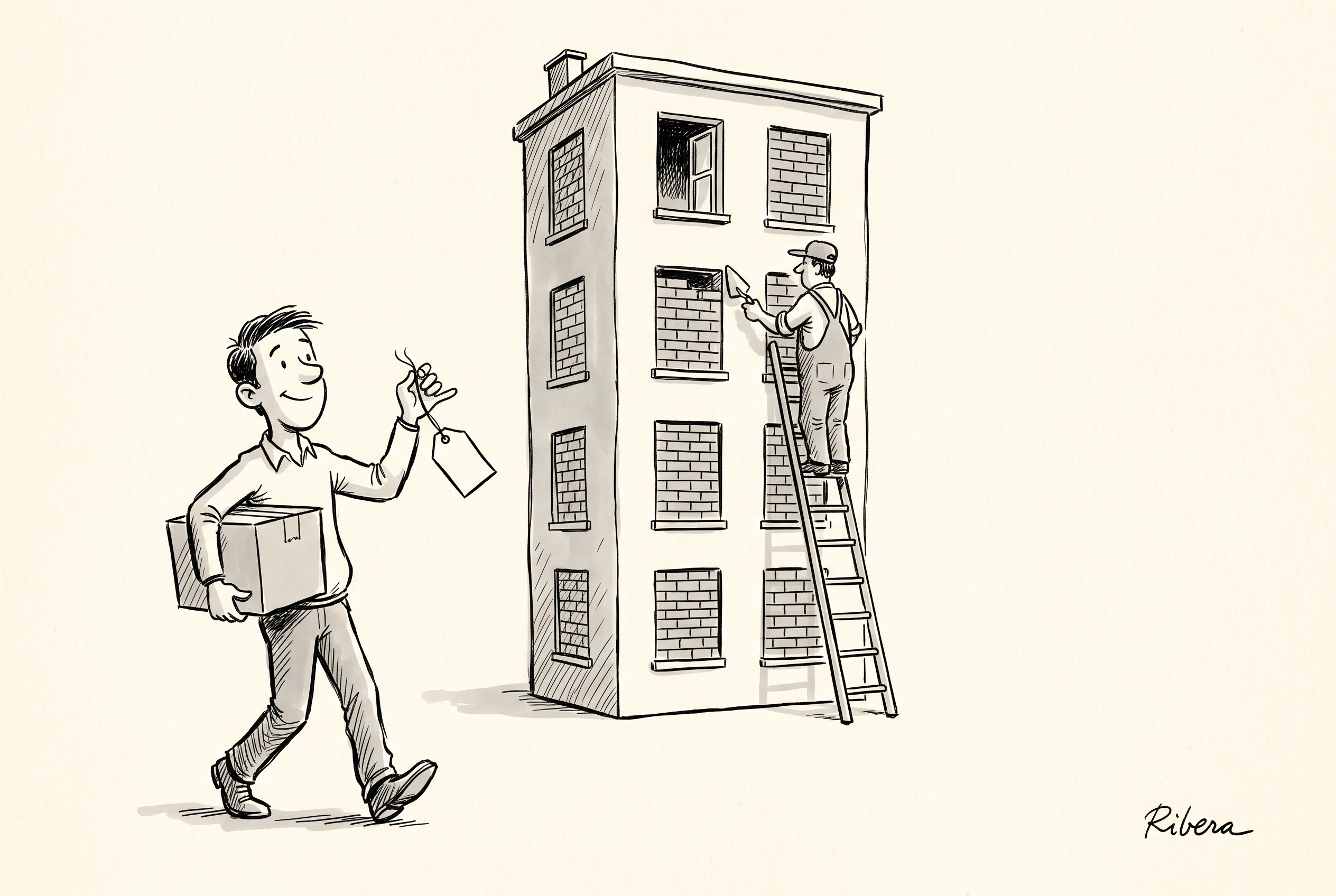
There is a quick way to tell whether a housing policy works: ask someone who has spent a month looking for a flat. This week the answer arrived in the form of data. According to idealista, the supply of rentals on its portal fell by 19% between September 25 and October 25: 26,531 fewer listings in thirty days. In Teruel the drop reaches 46%, in the city of Madrid 27% and in Barcelona 25%. The Balearic Islands stay flat, and Ceuta is the only provincial capital where it rises.
The calendar explains why that month matters. On September 29 the government approved two housing decree-laws, and on October 2 Congress struck down both of them, by 172 votes to 178 and by 166 to 184. After the dissolution of the Cortes, two more arrived on October 6, Nos. 28 and 29 of 2026, which now await the vote of the Standing Committee, scheduled for November 12. In between, a general strike called for November 11 with housing as its banner, and an election on the 29th. Rarely has a market had so many reasons to stand still.
It is worth being fair about what those decrees regulate, because they are not a whim. No. 29, in force since October 8, caps the annual rent increase at 2% until the end of 2027, allows tenants who are up to date with their payments to request an extraordinary extension of up to two years if their contract expires before 2029, and requires seasonal rentals to have a genuine, demonstrable reason. No. 28, which would enter into force on November 15, extends mandatory renewals to five years, or seven if the landlord is a company. Each of those rules responds to a well-known abuse: the contract renewed every year with a non-negotiable increase, the “seasonal” flat that is in fact someone's home.
The problem is that these measures protect those who already have a key, and do nothing for those still looking for one. If the number of homes for rent stays the same, a more stable rent for today's tenant is good news. If that number falls, the regulated price becomes a prize collected only by those who got there first. The young woman who moves to another city for work does not find a cheaper flat. She finds fewer flats.
The best argument against this reading deserves space, and it carries weight. A listing is not a home. Part of that drop may be seasonal supply being withdrawn or converted, owners waiting to see how Congress votes before signing, or flats rented without going through the portal. Moreover, the data comes from a single company, which has its own interests in the market. Until there are official statistics, drawing definitive conclusions from thirty days would be as hasty as approving decrees to the rhythm of the electoral calendar.
All of that is true, and even so it does not entirely convince me. Even if the real figure were half that, the signal would be the same: uncertainty holds back those who rent out. Even a local newspaper in the north of Madrid describes small landlords who prefer to put their plans on hold, sell or leave the flat empty. And a rule that may fall within a week gives no security to anyone, neither to the tenant who invokes the extension nor to the landlord who has to decide whether to renew.
What is most striking is that decree No. 29 itself contains the missing chapter, even though no one talks about it. It provides for ICO guarantees of up to 2,000 million euros for developers of social or affordable rental housing, 280 million for industrialized construction and a social impact housing fund with an initial 400 million. It also hands state land and buildings over to the public housing body. It is the part that can add homes, and it is the one moving most slowly: it has no timetable for completed homes and no public counter showing how many are under way.
What I am asking for is not to repeal the cap or to leave the market to its own devices. It is to reverse the order of priorities. That the Standing Committee, however it votes, not leave the supply measures half done. That the ministry publish every quarter how many affordable homes have been guaranteed, started and delivered. And that the INE and the contract registries measure real supply, so that the debate does not depend on whichever portal has the most listings.
Protecting tenants is a public obligation. But a tenant needs, before anything else, a home. If the decrees are discussed only in terms of price, those who already have one will win. Those looking for one will keep staring at a screen with fewer and fewer photos.
This story stands on its own facts. The Post Apocalyptic does not link it to other incidents unless the sources demonstrate a connection.
Sources
- La oferta de vivienda en alquiler cae un 19% tras los decretos de vivienda, según idealista
- La oferta de alquiler se desploma un 19%: desaparecen más de 26.000 viviendas en un mes
- Nuevos decretos de vivienda: qué cambia en el alquiler
- Reales Decretos-leyes 28 y 29/2026: qué cambia en el alquiler
- Sindicatos convocan una huelga general el 11 de noviembre
Public history
- — Published (editorial approval)