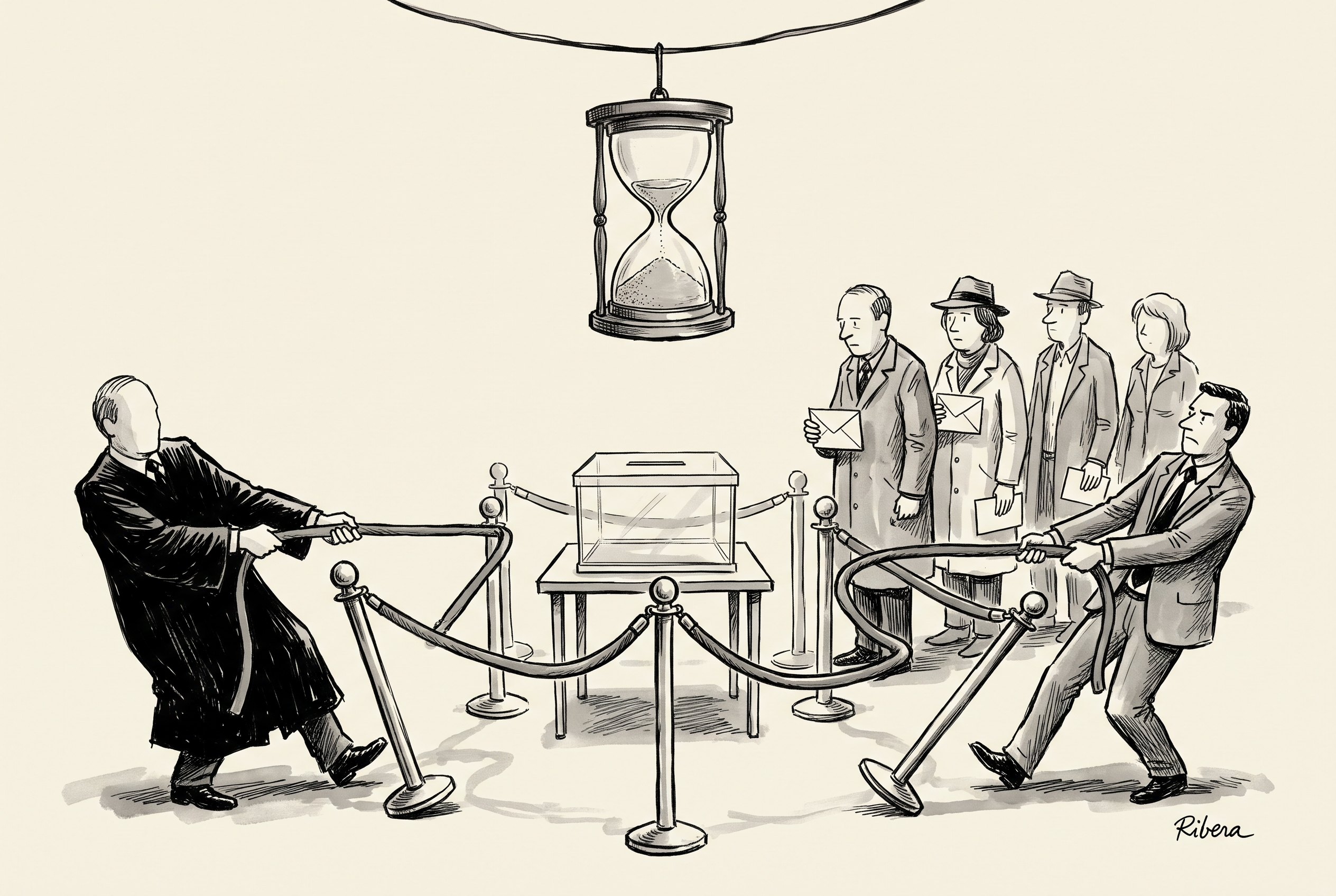
Since Wednesday the votes of Spaniards living abroad have been travelling around the world, and we still do not know for certain who is entitled to send them. As I write, the Tribunal Supremo, Spain's Supreme Court, is considering whether to extend the precautionary suspension of the vote to the children of those who obtained citizenship under the so-called grandchildren's law. Vox and Iustitia Europa are asking for it; the Government opposes it. There are twenty-three days to go until the general election of November 29, the campaign begins on the 13th and the ballot boxes at the consulates will receive votes between the 21st and the 26th. The electoral roll, which ought to be the most boring part of any election, has become its great unknown.
It is worth recalling how we got here. On September 8, the Supreme Court provisionally suspended the vote of 163,020 people who live abroad and obtained citizenship under the Ley de Memoria Democrática, the Democratic Memory Law, without proving that they descended from exiles. On October 12 it upheld the measure and rejected the requests of the Abogacía del Estado, the State Attorney's Office, and of the Fiscalía, the Public Prosecutor's Office, which argued that reviewing the files one by one before the vote was, in the Government's words, "materially impossible". The Defensor del Pueblo, the Ombudsman, went to the Constitucional, the Constitutional Court, which on October 21 declared its appeal for protection inadmissible by ten votes to two: it was premature, because the matter is still alive in the Supreme Court. On October 30, the Supreme Court refused to immediately suspend the children as well and gave the parties three days to state their views. That is the decision now pending.
I am not going to settle here who is right on the merits, not least because no court has done so yet: there is no ruling, only provisional measures. My complaint is a different one, and it holds whoever wins the case. A fundamental right such as the vote should not depend, three weeks before polling day, on a three-day hearing procedure. If in the end those votes count and later turn out to be irregular, doubt will fall on the deputies elected. If they do not count and later turn out to have been valid, we will have silenced thousands of citizens who did everything the State asked of them. Either way, what loses is confidence in the count, which is the one thing a democracy cannot afford to lose.
The best counterargument has been made by the Supreme Court itself, and it deserves respect. The court holds that the accuracy of the roll of absent residents is a priority, because any suspicion about it would call into question the legitimacy of those elected, and it warns of the sharp increase in voters abroad. Better, it is in effect saying, a precaution that can be lifted than a count that cannot be undone. It is serious reasoning. But it describes a fire that was allowed to grow long before the judges arrived.
Because the problem was not born in September. The law dates from 2022 and set out a route to citizenship that required certain conditions to be proven. What was not resolved in time was how those conditions would be checked before the new Spaniards entered the electoral roll. As of October 21, the Foreign Ministry had forwarded 31,390 files, 19.2 % of the 163,020 affected, and had issued 91 certificates of exile. At that pace, the Government's conclusion that there is no time is correct, and that is precisely why it is bad news: the review that is impossible today should have been done when citizenship was being granted, not when the ballot papers are being handed out.
Nor does it help that each institution has passed the ball to the next. The Junta Electoral Central, the Central Electoral Board, in a resolution of October 22, deferred the question of the children to whatever the court decides. The Constitutional Court said it was too early. The two justices who dissented warned of something that should make everyone uncomfortable: a fundamental right is being restricted by a precautionary measure and without the legislature having said a word. Meanwhile, those affected wait without knowing whether their envelope will count.
The election was called on October 6, when the suspension already existed. Whoever chose the date knew the risk, and those now asking to extend the precautionary measures are doing so with the calendar already running. Nobody is to blame for the courts having their own timescales, but they are to blame for not having put the roll in order before those timescales collided with the electoral one.
What I am asking for has no political colour. Whoever wins on November 29, the new Cortes, Spain's parliament, should write into law that doubts over who can vote are settled before an election is called, not during the campaign: checking of conditions at the moment citizenship is granted, clear deadlines for challenging the roll and a date after which the lists are not touched. That protects both those who fear fraud and those who fear exclusion, which are two legitimate and opposite fears.
A democracy can argue for years over who should be Spanish. What it cannot do is decide in three days, with the envelopes already in the post, who gets to vote.
This story stands on its own facts. The Post Apocalyptic does not link it to other incidents unless the sources demonstrate a connection.
Sources
- Temas del día de EFE España del miércoles 4 de noviembre de 2026
- El Supremo estudia suspender también el voto de los hijos de nacionalizados por la ‘ley de nietos’
- El Supremo aplaza su decisión sobre el voto de los hijos nacionalizados por la ley de nietos
- El Supremo mantiene la suspensión del voto de 163.020 nacionalizados por la ley de nietos para las elecciones del 29N
- Defensor del Pueblo recurre al Constitucional para que la ley de nietos no deje sin voto el 29-N
- El Tribunal Constitucional rechaza el recurso del Defensor del Pueblo para devolver el voto a 163.020 nacionalizados por la ‘ley de nietos’
- Ley de Nietos: piden al Supremo que extienda las cautelares a los hijos mayores de edad de los beneficiados
- Iustitia pide ampliar la suspensión del voto por la ley de nietos
- El BOE publica el real decreto de disolución de las Cortes y la convocatoria electoral para el 29 de noviembre
Public history
- — Published (editorial approval)